


Mountain Guide Scotland: Choosing Between Two Winter Routes
Two routes. Same forecast. Same car park. And one of them is going to suit the day way better than the other. That's the decision a mountain guide in Scotland makes most mornings, often before the group has finished their flask of tea. Winter route selection Scotland isn't about picking the line that looks coolest on the map. It's about reading snow, wind, light and people, then choosing the route that still makes sense at three in the afternoon when things have changed. Here's how I actually do it, plus the mistakes I see people make most often.
Table of Contents
Quick Takeaways
Key Insight | Explanation |
|---|---|
Always have a named backup route | One option is a plan, two is a decision. Pick the second line before you leave the car, with a clear reason it could work. |
Wind often decides more than snow | Strong wind loads the leeward slopes and can make a ridge a bad idea even when the surface looks firm. |
Read where the snow has been | Recent slides, fresh cornices and melt-freeze crust tell you more than a single forecast headline. |
Plan for the slowest person | Your route should suit the weakest member of the team on a bad day, not the strongest on a good one. |
Set a turnaround time early | Work back from daylight. If you can't reach the top and get down before the light fades, choose the bail route. |
Descent is part of the route | A line you can't get off safely is the wrong line, however good the climbing looks from below. |
Why Two Routes End Up on the Table
Usually it's not because someone's being fancy. The first plan gets wrecked by the forecast, the snow, or the simple fact that the group woke up slower than planned. Sometimes both routes look fine on paper, and the day just has to pick one. That's where the real work starts.

Here's the thing I tell new clients. You should always have a second route in your head before you leave the car. Not a vague "we'll see how it goes." A named line with a clear reason it might work. If you only have one plan, you're not making a decision. You're hoping.
The plan A that falls apart by lunch
Picture a typical winter morning. The gully you picked looks brilliant from the road, all white and fat. Then you get to the base and the lower pitch is wet, the upper bit is plastered in spindrift, and someone in the group is already shivering after standing around for twenty minutes. Nothing about that is a disaster. It's just the normal grind of Scottish winter climbing.
Why the second option is never a throwaway
A backup route isn't a sad consolation prize. It's often the better call for that particular day. A ridge might be the obvious pick in a settled spell, but on a windy morning with poor visibility, a sheltered gully on the same hill can be the smarter choice. So I look at both options with equal seriousness, even if one of them is my favourite.
Same forecast, different risks
Two routes can sit on the same hillside and face completely different problems. A gully funnels snow and can become a trap if the slopes above are loaded. A ridge is airy and exposed, so wind that barely bothers you at the bottom can knock you off balance up top. Read the forecast with the route in mind, not the other way round.
Reading the Snow Before the Map
Maps tell you where things are. Snow tells you whether they're worth climbing today. Those are two very different jobs, and on a Scottish winter day the snow usually wins the argument. The same line can be a delight one week and a death trap the next, which is exactly why the snowpack gets the most attention in my head.
I start with what the snow has been doing over the last few days, not just what the forecast says about tonight. Recent avalanches, fresh cornices and the shape of the snow around you tell you a lot more than one headline number ever will.
Wind slab tells you where not to go
Wind is the sneaky one. It picks snow up from the windward side and dumps it on the leeward side, often in a smooth, hard layer that looks perfectly safe. If you hear a hollow thud or see cracks running across the surface, you've probably found wind slab. On a route that crosses a loaded slope, that's your cue to look for the other line, even if it means a longer walk.
Ice that looks good from the road
Ice in Scotland can be a wonderful liar. From a distance a flow looks fat and continuous, but up close you find it's thin in the middle, rotten at the base, or only there because the sun hasn't got to it yet. Thaw and refreeze cycles change ice fast, so a route that was perfect last week can be a different beast today. I'd rather walk away from a flow I can't read than swing into something I don't trust.
The skill that matters most isn't swinging the axe. It's reading the conditions, the forecast, and how both change the climb and the way back down.
Which way the slope faces
Aspect matters because sun and wind hit slopes differently. A slope facing away from the sun holds cold, firm snow and ice for longer. A sunny face might have been baking all morning, turning the snow soft and unstable. Some routes I'd happily climb in the shade become sketchy the moment the sun reaches them, so the time of day matters as much as the angle.
Pro tip: Before you commit, spend five minutes just looking at the snow surface around the base. Cracking, a dull thud under your boot, or fresh avalanche debris are all reasons to pause and re-plan.
Weather, Visibility and the Clock
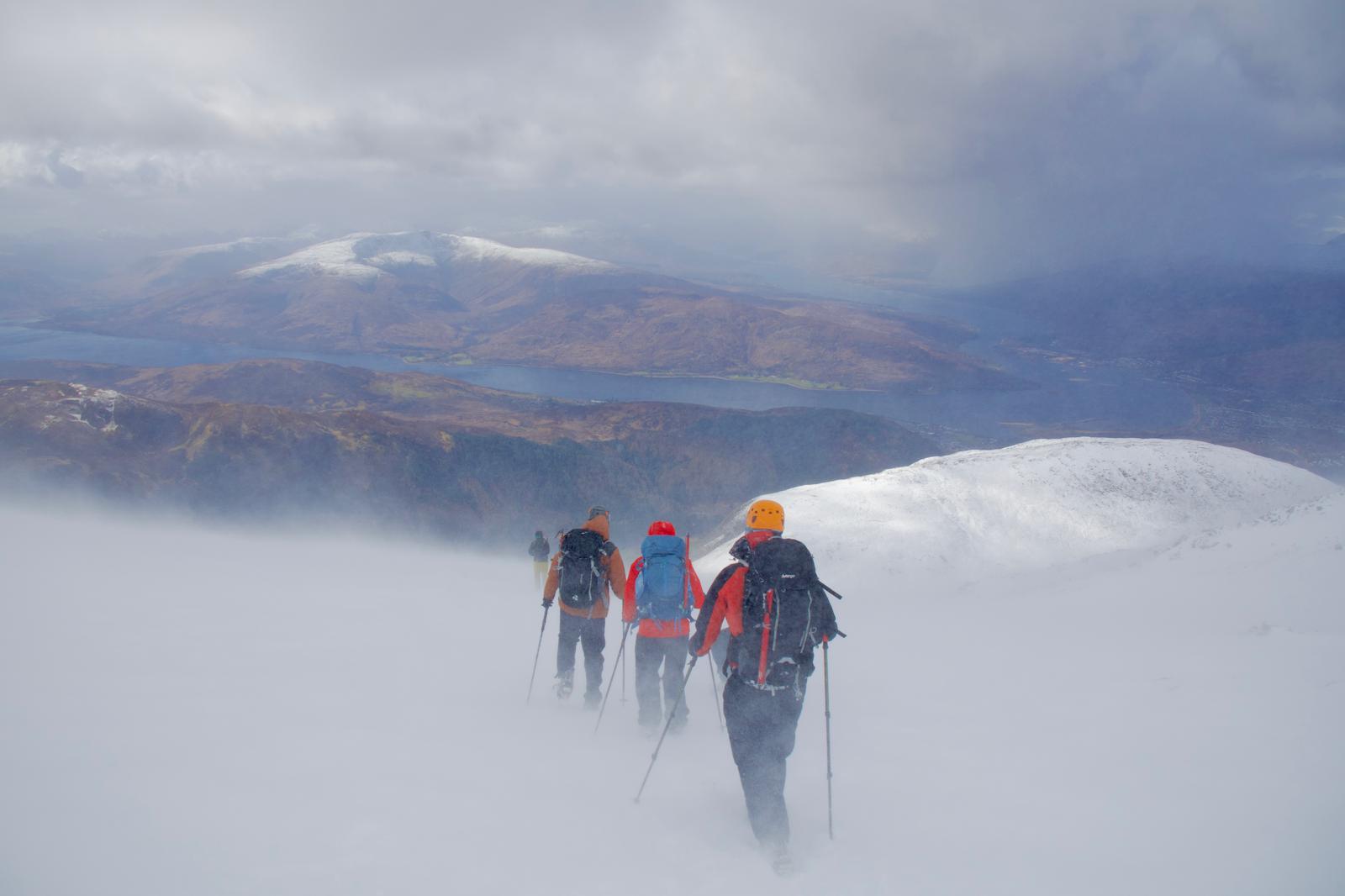
Scottish winter weather doesn't really do gentle. A morning that looks calm from the car park can turn into a whiteout on the top plateau in the time it takes to eat a flapjack. That's why I treat the weather as a set of questions rather than one forecast: how strong is the wind, where's the cloud base, and when does the light go?
Cloud base and the navigation problem
If the cloud is sitting on the tops, a ridge with tricky navigation becomes a different proposition. A gully has walls that keep you on track, while an open ridge can leave you guessing your bearing with the compass in your hand. If the group can't navigate in poor visibility, the ridge is off the table, however good it looked on the walk in.
Wind speed is the number that decides ridges
A breeze that's fun on a sheltered approach can be seriously hard work on an exposed crest, and gusts are harder to judge than averages. I'd much rather have the group in the gully than balanced on a knife-edge in a squall. If the wind is building through the day, expect the ridge to be less friendly by early afternoon.
Daylight is a hard stop, not a suggestion
Winter days are short, and across Scotland the light can drop fast once the cloud closes in. I set a turnaround time before we leave the car. If we're not at a certain point by then, we take the bail route, even if the summit is right there. Summits are optional. Getting back in the dark with cold, tired people is not.
Matching the Route to the Team
The best route on paper is the wrong one if the group can't climb it safely. This is the part that stings, because people often arrive with a shopping list of classics and high expectations. My job is to find the line that gives them a great day, not the one that makes them feel small when it goes sideways.

Honest ability matters more than claimed ability. Nervous people tend to inflate their experience, and nobody wants to be the one who says "actually, I'd rather not." So I ask specific questions. How long since you last led something steep? How do you feel on ice? What happens to your hands when you stop moving?
Honest ability, not the one people claim
I ask people to describe their last winter day, not their CV. If someone has done plenty of easier grades but can't remember the last time they placed a protection screw in steep ice, that tells me where to pitch the route. A mixed group needs the line that suits the weakest person on a bad day, because that's who the day will test.
Pace, cold and the slow member
Pace is a bigger deal than most people think. A route that takes six hours for a strong team can take nine for a group that's chilled, tired or slower on the snow. Watch for the person who keeps stopping, the one whose fingers are going white, or the one who has gone quiet. Those are signals to pick a shorter route before the day gets away from you.
Who leads the hard pitch
Leading changes the sums. A route with one short, steep pitch might be fine for a confident leader and a bit much for a team where nobody's led ice before. Sometimes the right answer is the route with a clean, sensible crux the group can handle together, and the harder line waits for a day when the team is ready.
Escape Routes and the Bail Plan
Every route is a commitment. The question I ask is simple: if something goes wrong halfway up, where can we go? A route with a good escape line is worth more than a slightly better line with no way off, especially in winter when the weather can change in minutes.
Descent is part of the route, not an afterthought. I'd rather choose a line I can walk off safely than one with a fantastic top pitch and a nightmare way down. Plenty of people focus on the climbing and forget that the descent is often where the real risk hides.
Where can you walk off from the middle?
Before committing, look for natural exits. Does the route have a point where you can drop into a safer line? Is there a clear path off the ridge, or do you end up stuck with the top as the only option? If the honest answer is "not really," the route needs better conditions and a more experienced team before I'd even consider it.
Turning round without losing face
The hardest part of the bail plan is the social bit. Someone has travelled a long way, they're keen, and you're the one saying no. I make the turnaround a team decision from the start, so it doesn't feel personal. Nobody fails by turning round. The day is just doing its thing.
The descent you didn't plan for
A common mistake is planning the ascent in detail and assuming the way down will sort itself out. It won't. Look at the descent before you go up, and make sure it's a route you'd still choose if the snow got worse. If it isn't, you're not really choosing a route. You're choosing a gamble.
Pro tip: Write your turnaround time on a card in your pocket or on the back of your glove. It sounds silly, but when you're tired and the summit's close, a number you set in the car park holds up far better than a decision made on the ridge.
Comparing Two Routes Side by Side
Here's the comparison I run in my head on most days. It's not a formal scoring system, just a quick look at what each option gives you and what it might cost. The categories stay the same whether you're on a famous classic or a quiet corner nobody talks about.
Sheltered gully versus open ridge
The gully usually wins on shelter and navigation. Walls keep the wind off, and it's easy to keep your bearing. The downside is that it can funnel avalanche debris and collect loaded snow, which makes it a trap if the slopes above are unstable. The ridge is the opposite. It's great when the snow is firm and the wind is light, but it's unforgiving when the weather turns.
When a mixed face makes sense
Mixed faces, where you combine rock and ice or snow, are the middle ground. They often have better escape options than a long open ridge, but the climbing can be more technical. If the team is solid on rock and the ice is in good condition, a mixed face can be the best of both worlds. If not, it's a short, fast route to a bad afternoon.
Route Type | What It Gives You | Where It Goes Wrong |
|---|---|---|
Sheltered gully | Wind protection, a clear line of travel and easier navigation in poor visibility | Loaded snow can funnel down the line, and a thin ice pitch can turn the day into a long wait |
Open ridge | Big views, a real sense of mountaineering and a direct line to the top | Gusty wind, tricky navigation in cloud and few options to bail if the weather closes in |
Mixed face | Varied climbing and reasonable escape options if you pick the right line | Technical moves that slow a group down, and conditions that change quickly as the day warms |
Read the table as a prompt, not a rulebook. The right choice depends on the day in front of you, and the same route can flip from good to bad between morning and afternoon.
Making the Call and Saying It Out Loud
By the time we reach the base, I've usually been thinking about this for a while. Now it's time to make the call and say it clearly. Vague decisions cause confusion, and confusion is what gets people hurt on a cold day.
I keep it simple. Here's the route, here's why, and here's the point where we'll reassess. Everyone should know the plan well enough to say if they think something's off. That's not a formality. It's a safety check.
The five-minute huddle at the base
Before we move, I gather everyone in a tight huddle and go through the options out loud. Where we're heading, what could change, and what we'll do if it does. It takes about five minutes and saves a lot of confusion later. People also speak up more easily when they've been asked for their view.
Commit, but keep a clock
Once you've chosen, commit fully. Dithering halfway up a gully is more dangerous than a wrong decision made calmly. At the same time, keep your turnaround time visible and check it at every stop. Commitment and flexibility can live together if you've planned for both.
Changing your mind without drama
Changing your mind isn't failure. A good guide switches plans when the snow, the weather or the group tells them to. What matters is that the switch is calm, planned and explained. "Snow's worse than we thought, so we're taking the gully instead" lands far better than sudden silence and a change of direction.
Pro tip: If you're a guest on a guided day, ask your guide what would make them change the plan. Their answer tells you a lot about how they think, and it helps you spot changes early too.
Frequently Asked Questions
How does a mountain guide in Scotland decide which winter route to take?
They start with snow stability, wind, visibility and daylight, then match the options to the group's honest ability. The right choice is the route that still works if conditions get worse, not just the best-looking line from the car park.
Do I need to be an experienced climber to join a guided winter day?
Not always, but you do need to be honest about what you can do. A good guide will adjust the route to your level, and our introductory courses are built for people who are still learning. Tell us your real experience so we can plan properly, whether you're heading out of Fort William or joining a course on the Isle of Skye.
What's the biggest mistake people make when choosing a winter route?
Picking the route they've been dreaming about and ignoring the conditions. Ambition is good, but on Scottish winter ground the snow and weather make the final call, and a route that's wrong for the day is usually wrong for everyone on it.
Why do guides sometimes change the route after leaving the car park?
Because the mountain doesn't read the plan. Snow can look different at the base, wind can pick up on the approach, and the group might be slower or more tired than expected. Changing route early is almost always the safer and smarter option.
Can I learn to climb in Scotland in winter without a guide?
You can, if you have the skills, the right kit and the judgement to read conditions. Plenty of people start with a guide because the decisions in this article are hard to pick up from text alone. If you're going it alone, spend time learning the snow and the weather before you commit to bigger lines.
I'd love to hear about the winter day when you had to choose between two routes, so tell us how you made the call.


Comments