


Ben Nevis Climbing Guide: What Route Choice Reveals
Here's the thing nobody tells you about hiring a Ben Nevis climbing guide. The summit is the least interesting part of the day. What matters is the line your guide picks to get there, and whether they change it when the weather or the snow says so. A guide who sticks to one plan no matter what is telling you something important, and it's rarely good news. In this piece I'll walk you through what route choice reveals about judgement, what to look for on the day, and the questions worth asking before you book.
Table of Contents
Quick Takeaways
Key Insight | Explanation |
|---|---|
Route choice is a decision log | Every line your guide picks shows what they weighed, from snow and wind to daylight and your group's pace. |
A fixed plan is a warning sign | If the route can't change when conditions change, the guide is working from a script, not reading the mountain. |
The summer path is not a winter plan | The Mountain Track is an easy walk in July. Under snow and cloud it becomes a different day entirely. |
The plateau in cloud is the main hazard | The top of Ben Nevis is in cloud roughly 70% of the time, so navigation skill matters more than the view. |
Daylight sets your turnaround time | In late December it's light at about 9 am and dark well before 4, so a slow start eats your safety margin fast. |
Ask for the plan B out loud | A good guide can name the bail-out point, the fallback line and the time they'll turn around, without checking a map. |
What the Route Choice Actually Tells You
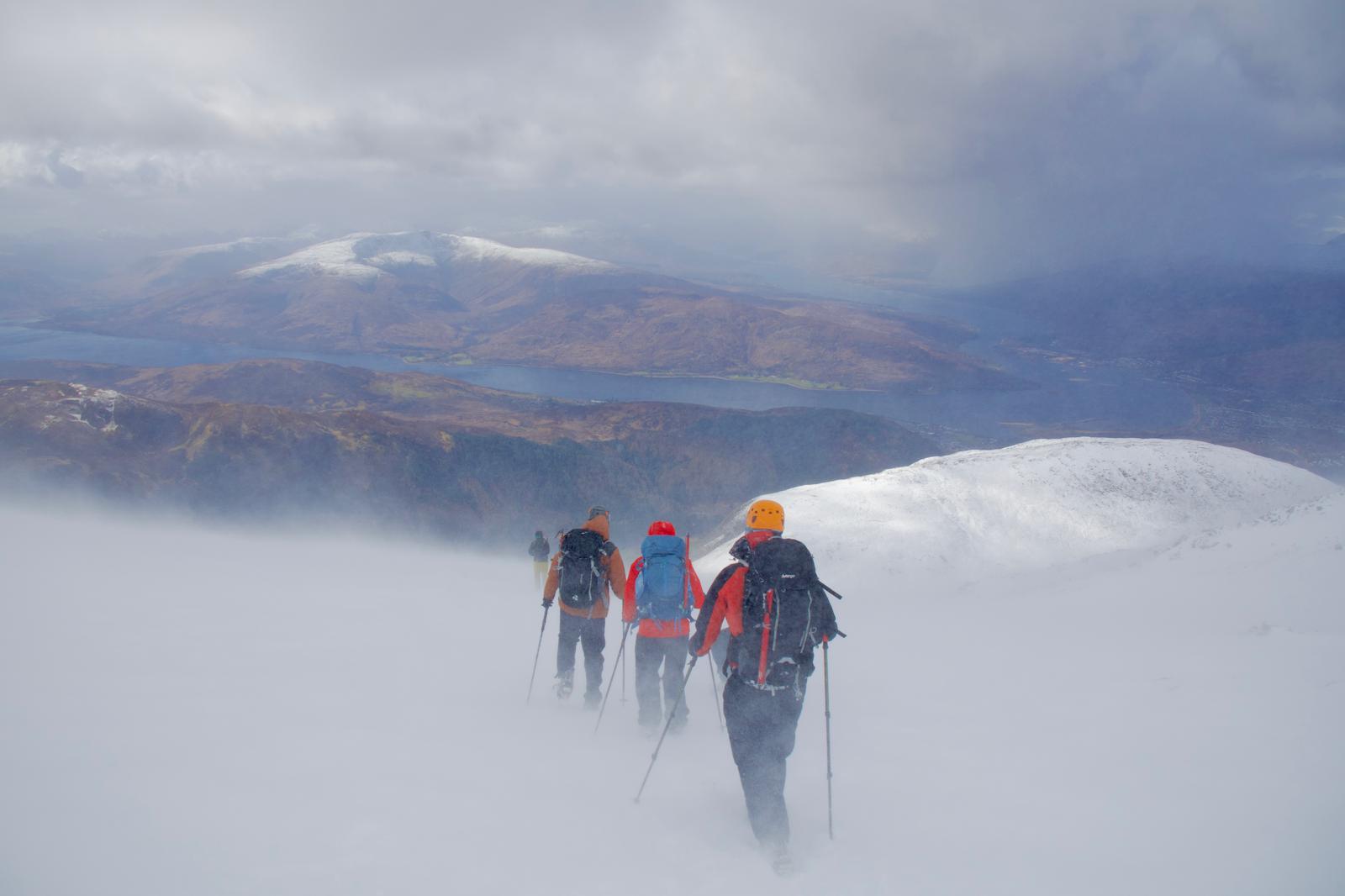
When a guide stands at the bottom of the hill and says, "Right, we're going this way," they've just shown you their homework. Every winter route on Ben Nevis is a bundle of decisions. Snow depth, wind, how much daylight is left, how tired your legs will be at the two-hour mark. You don't see most of that thinking, but the line they pick is the result of it.

Here's what I actually look for. A guide who talks about the route before they talk about the summit is thinking like a professional. They'll tell you what they expect the ground to be like, where the hard bit is, and what would make them change plans. That conversation tells you more about the day than any gear list ever will.
The summit is the least useful test
Bagging the top is the easy part to sell. Anyone can get you to a cairn on a clear day with a good forecast. The real test is what happens when the top isn't on offer. Does your guide turn around calmly, or does the summit still feel like the whole point of the trip? The second one is a bad sign.
Honestly, I'd rather go home from a turned-back day with a guide who made a sensible call than from a summit day with one who got lucky. Luck is not a plan. The guide's job is to make the day repeatable, and that means the route choice has to hold up when the weather doesn't cooperate.
Why conditions should drive the line
Winter ground changes by the hour. Snow that felt firm at the start can be a different animal higher up. Wind and aspect can make one face of the mountain very different from another, even a short distance away. A guide who checks conditions on the morning, rather than relying on last week's plan, is showing you real respect for the mountain.
What a Good Guide Checks Before the Line
Before a good guide commits to a route, there's a mental checklist running in the background. It's not secret. It's just a bit boring, and boring is exactly what you want from a professional. Here's what I'd expect them to weigh up on a Ben Nevis day.
Visibility and navigation on the plateau
The summit plateau is where good days go wrong. The top of the mountain is in cloud roughly 70% of the time, so you should assume you'll be navigating in poor visibility at some point. Winter makes it harder, because snow covers the features you'd normally use to find your way. A good guide plans the route around things they can actually find in cloud, and they carry a bearing they'd trust with visibility close to zero.
Be wary of anyone who says they'll "just follow the footsteps." Following the crowd works right up until the crowd goes the wrong way. Drifting toward the south side is a well-known trap when people lose the thread in poor visibility, and the tops of some north face gullies are dangerous ground to stray near. Your guide should be able to explain where those hazards sit relative to their line.
Daylight and turnaround time
Winter daylight is short, and it's the factor people underestimate most. One local forum thread describes light at about 9 am and darkness well before 4 pm in late December. That leaves very little slack once you've added the approach, the climb and the walk back down.
Allow for the round trip too. The summer figures for the Mountain Track put the round trip at 16 to 17 km with 1,300 to 1,350 m of climbing, and walkers usually allow 7 to 9 hours. Winter ground is slower, so a good guide builds in more time, not less.
Snow that is soft enough to trick you
Snow can be soft enough to walk up without crampons or an ice axe one morning and hard enough to make a descent dangerous by the afternoon. Experienced people know conditions can change by the hour. A guide who picks a line based on one morning's feel, with no fallback for when the snow firms up, is gambling with your day.
Red Flags in a Route Plan
Some warning signs are loud. Others only show up when you ask a second question. Here's what I'd be wary of, whether it's a guide I've never met or one with a glowing review on their website.
The same line, every single time
If every Ben Nevis day ends up on the same line regardless of snow, wind or group, the guide isn't reading the mountain. They're reading their own habits. Good guides have a favourite route, but they'll happily drop it when conditions don't match. Ask what would make them change the plan. If the answer is "nothing," walk away.
A route that can't change with the mountain is just a timetable.
No plan B you can repeat back
A plan that only works if everything goes right is not a plan. Ask where they'd turn around, which features they'd use to bail out, and what they'd do if the group were slower than expected. A solid guide can answer that in a sentence or two. If they hesitate, that hesitation is useful information.
Pro tip: Ask your guide to describe the bail-out point before you leave the car park. If they can't name one, you've learned what you needed to know before the day starts.
A route pitched above your group
The most common mistake I see is a route that's too big for the people on it. A group new to winter, put on a steep or exposed line because it looks great in a photo, is a group in trouble. Honest guides scale the ambition to the people in front of them. If you're new to this, a clear step-up route is far better than a grand objective you can't reach safely.
Why the Tourist Path Is Not a Winter Plan
The Mountain Track is the most walked way up Ben Nevis, and in summer it's a solid path. Well over 100,000 people a year walk up the mountain, and the John Muir Trust puts the figure at more than 160,000. It's a made path all the way, and on a clear summer day it's hard to get lost. That's exactly why it's a trap when people assume winter works the same way.
Under snow and ice, the same ground can be a completely different day. The path may be buried or hard to follow, the footsteps you're tracking may belong to someone who already turned back, and the stones you'd step over in July become a slippery mess. A guide who says "we'll just take the tourist path" in winter is either underestimating the day or hasn't thought it through.

Summer path, winter ground
In summer, a walker who loses the path can usually find their way by sight. In winter, the same walker can be standing on an empty white slope with nothing to hold onto. That's why a summer route choice tells you very little about how a winter guide thinks. The right winter line is chosen from scratch, with the snow in mind.
Cloud turns a simple walk into a navigation test
The big summit risk is cloud, and the top is in cloud roughly 70% of the time. Volunteer mountain rescue teams are regularly called to searches for missing hillwalkers, and on the plateau in cloud that's usually where the trouble starts. Map, compass and a set turn-back time matter on every single day, not just the dodgy ones.
Route Options Compared
Here's where the decision gets concrete. Three broad approaches come up on Ben Nevis, and each one tells you something different about the person leading you. Treat this table as a way to sort the options, not a rulebook you have to follow to the letter.
Route approach | What it tells you about the guide | When it makes sense |
|---|---|---|
Walking the summer path under winter conditions | The guide is reaching for the easy option without reading the day | Rarely. Only when there's little snow and the cloud is high |
Winter plateau route chosen on the morning | The guide checks conditions, daylight and group pace before committing | Most winter days, especially with a mixed-experience group |
Steeper north face line | The guide knows the ground well and has the margin to handle it | Stable snow, a confident group and a clear turn-back plan |
What the top row really says
I'd be most nervous about the first row. Choosing the summer path in winter usually means the guide is working from habit. It isn't always dangerous on the day, but it shows a lack of reading the mountain. If you hear that plan, ask what they've changed for the season. A good answer will be specific.
Why the middle row wins most days
The second row is where good winter guiding lives. It's flexible, a bit boring, and usually the day you walk away from happy. The guide has checked the snow, the cloud and the clock, and picked a line that suits the people on the rope. Confidence without reasons is just noise, so listen for the reasons.
The third row is the one I'd take seriously only with the right people and the right snow. A north face line can be an excellent day, but it needs a guide who knows exactly where the hazards sit and a group that can follow instructions without argument.
How Group Size and Experience Shape the Route
Group size changes the route more than most people expect. A bigger group moves more slowly, spreads out on steep ground and makes every decision harder to pass along. A good guide adjusts the line and the turn-back time to match, and they'll tell you why. If you want a deeper look at this, our piece on how group size affects your mountain guiding experience covers the practical side.
Mixed-ability groups
When one person is much stronger than the rest, the guide should plan for the slowest member, not the fastest. That isn't a comfort decision. It's a safety one. Ask how they'll handle a slow walker on the plateau and whether the group would split up. Splitting a group in cloud is rarely a good idea, and a guide who says they'd do it casually hasn't thought hard enough about it.
Your first winter day
If it's your first time on Ben Nevis in winter, you want a route that teaches you something without scaring you off. Start with a clear, moderate line, learn the navigation and the crampon work, and build from there. Daylight is the other big lesson, so it's worth reading why short days change your pace on Ben Nevis before you commit to a start time.
Pro tip: Tell your guide your honest winter history, including the days you turned back. It changes the plan for the better, and a good guide will be glad you said it.
What to Ask Before You Book
You don't need to be a mountaineer to ask good questions. You just need to ask them early, before you've paid and before the forecast has you hooked. Here's a short list of what I'd put to any guide, including us.
Questions about the plan
Ask which route they'd choose in the current forecast and what would make them change it. Ask how they check snow and cloud on the morning of the day. Ask where the turn-back time is set and who makes that call. You're listening for specifics, not reassurance.
Questions about the group and the kit
Ask how many people they take and how they'll manage a slower member. Ask what kit you'll need, because a guide who doesn't mention crampons, an ice axe or a head torch for a winter day is a worry. Be honest about your own experience too, since that's how you end up on the right route. For more on how a guide plans a winter day from start to finish, see how we plan a safe winter ascent.
What to do if the plan changes
Plans will change on Ben Nevis. That's normal. What matters is how the change is handled. A good guide tells you early, explains the new line and keeps the group together. If all you hear is "it'll be fine," ask again. If you're still unsure, get in touch with us at climb@atlasmountaineering.com or call +44 7446191098 and put the same questions to us directly.
Frequently Asked Questions
How can I tell if a Ben Nevis guide has good judgement?
Listen for specifics. A good guide will tell you how they check conditions, what would make them change the route, and where they'd turn back. Vague reassurance with no plan B is the warning sign to pay attention to.
Do I need crampons and an ice axe for a guided Ben Nevis winter day?
In winter conditions, crampons and an ice axe are usually part of the kit list, and snow can change quickly on the mountain. Your guide should confirm exactly what you need before the day, so you aren't finding out at the car park.
Is the Mountain Track safe to walk in winter?
It isn't a safe default. The Mountain Track is a made path in summer, but snow, ice and cloud can hide it and make navigation hard. Treat it as a summer route and plan the winter day from the conditions up.
How long does a Ben Nevis round trip take?
The summer figures are 16 to 17 km round trip with 1,300 to 1,350 m of climbing, and walkers usually allow 7 to 9 hours. A winter day with snow and ice will generally take longer, so build in margin from the start.
What is the difference between a guided day and a winter skills course?
On a guided day, your guide chooses the line and manages the mountain on your behalf. A course like Ben Nevis Winter Skills is about building the skills to make those decisions yourself, which is why many people do one before the other.
Can I book a guided Ben Nevis climbing day from Fort William?
Yes. We're based in Fort William, and you can get in touch by email at climb@atlasmountaineering.com or by phone on +44 7446191098 to talk through your plans and experience.
Have you ever had a guide change the route on the day, and did it feel reassuring or frustrating?


Comments