


Scottish Winter Skills That Carry Over to Alpine Routes
Here's the thing nobody tells you about Scottish winter climbing skills: they're basically training for mountains you haven't climbed yet. Ice axe work, belays, and reading snow don't change when you fly out. The glaciers, the altitude, and the long days do. I've watched plenty of keen climbers arrive in the Alps with a head full of Scottish confidence and get humbled in the first week. So let's sort out what actually carries over, what doesn't, and how to build up sensibly.
Table of Contents
Quick Takeaways
Key Insight | Explanation |
|---|---|
Your axe and crampon technique is the same everywhere | Swing, placement, and footwork on steep neve work in Scotland and on an Alpine couloir. Get it solid at home before you go. |
Scottish belays are the real head start | Snow and ice anchors you build in a Highland gully are the same anchors you'll use on a glacier approach or a steep Alpine face. |
Short days teach you to move fast | Scottish winter routes often mean tight timings. That habit pays off on long Alpine days where you're starting in the dark. |
Glaciers are the big gap | Crevasse rescue, roped travel on ice, and reading a glacier surface aren't covered by a typical Scottish course. Book that training separately. |
Altitude is a different sport | Acclimatisation and altitude sickness don't show up on Ben Nevis. Treat Himalayan trips as a new skill set, not an extension of Scottish winter days. |
Build the ladder one rung at a time | Scottish winter, then an Alpine course, then a Himalayan expedition. Skipping steps is where most people get into trouble. |
Why Scottish Winter Is a Useful Starting Point
Scotland gets a bad rap for being wet and grumpy, but that's exactly why it's such a good classroom. The weather doesn't care about your plans. Gale force winds, low cloud, and sudden whiteouts are a normal part of a Scottish winter day, and they force you to make decisions fast. Those decisions are the foundation for everything you'll do higher up.

The other big plus is cost and access. You can get out on a winter route from Fort William or from the Isle of Skye on a single weekend, with no passport, no flights, and no altitude to worry about. That means more days on the rope, more mistakes you can afford to make, and more reps on the basics before the stakes go up.
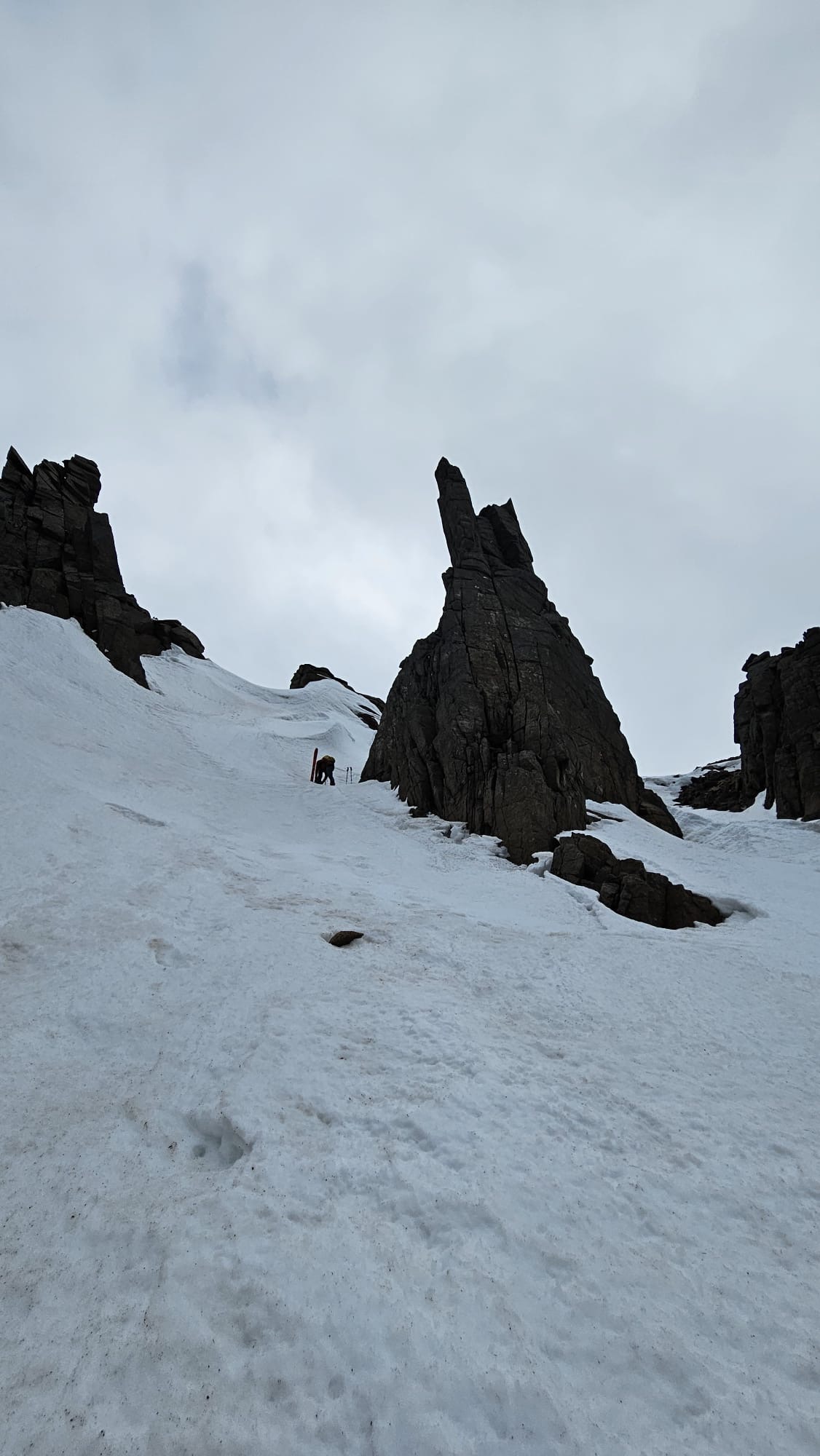
A common mistake is treating Scottish winter as just a warm-up. It isn't. The Cuillin on Skye and the big north-facing corries on Ben Nevis will test your judgement as hard as any Alpine route, just on a shorter fuse. If you can read snow and weather well here, you're building the core habits that matter most later.
Skills That Transfer Directly
Some skills move across borders without any changes at all. The trick is knowing which ones they are, so you can focus your energy on the rest. In practice, three areas carry over almost completely: tool and footwork technique, building snow and ice protection, and moving safely on a rope in winter conditions.
Ice axe and crampon technique
Your axe swing and your crampon footwork don't care whether the slope is in Glen Coe or below a serac in the Alps. Flat-footing, French technique, and front-pointing all get used on both. The steeper and icier the ground, the more those basics matter, and the more time you've spent on them in Scotland pays off.
Look, a lot of people think a good axe placement is about strength. It's not. It's about reading the ice, keeping your weight over your feet, and using short, controlled swings. Get that habit right on a Scottish gully and you'll look calm on a steep Alpine face, even when your heart says otherwise.
Snow and ice belays
Building a bomb-proof belay in névé or hard snow is one of the most useful things you'll learn in Scotland. Deadmen, snow stakes, and ice screws work the same way on a glacier or a Himalayan ridge. The difference is that Scotland makes you do it in a hurry, often while wet, cold, and tired, which is the most realistic training you can get.
Pro tip: Build at least ten belays in Scotland with your eyes closed, then do them again with your gloves on. If you can build a solid anchor with numb fingers in a gale, you're ready for most of what the Alps will throw at you.
Rope work and moving together
Moving together on a rope, managing rope length, and communicating over the wind are skills you'll use on almost every mountain you ever climb. Scotland throws in plenty of awkward terrain where the team has to move at the same pace. That's a big deal on Alpine ridges, where a slow partner can turn a planned day into a very long one.
Where Scottish Experience Falls Short
Here's where I see people get caught out. Scottish winter teaches you a lot, but it doesn't teach you everything, and it can give you false confidence about the parts it skips. The biggest gaps are glacier travel, altitude, and the sheer scale of big mountain days. Those aren't small things, and they don't get better by thinking harder about your axe placements.
Scottish winter climbing is also very short on glaciers. There are no crevasses to rope up for on a typical Scottish day, so crevasse rescue is something you'll need to learn from scratch. The same goes for the way snow behaves on a big, sun-facing Alpine face, which can change in hours. Scotland's conditions teach you to respect wind and cold, but the Alps teach you to respect heat, slope aspect, and timing.
Scotland builds your judgement. The Alps and the Himalaya test it in ways Scotland never will.
A common mistake is assuming a strong Scottish season means you're ready for a big Alpine objective. It usually means you're ready for the next course. Use your Scottish winter days to sharpen the basics, then book targeted training for the terrain you don't know yet.
Pro tip: Keep a simple log of every Scottish day, noting snow conditions, what you built, and where you hesitated. Those notes will show you exactly which skills are solid and which ones still need work before you head abroad.
Winter Climbing Progression for Alpine Terrain
The smartest route into the Alps is a step-by-step progression, not a leap. Start with a solid winter skills base in Scotland. Then add a course that focuses on glacier travel and Alpine-style planning. Only after that should you start thinking about a big objective. It sounds slow, but it's the fastest way to actually get up something.
Glacier travel and crevasse rescue
Glacier travel is the skill most Scottish climbers haven't practised. Roped travel on a glacier means you're protecting against falls into hidden crevasses, not just a slip on a slope. You'll learn how to space the rope, how to probe, and how to set up a crevasse rescue system if someone goes in. None of this is hard to learn, but it's very easy to learn badly without a good instructor watching.
In practice, most people find the rescue drills the hardest part. Hauling a partner out of a crevasse with a 3:1 system is slow, awkward, and exhausting. Practise it until it's boring. Boring is what you want when the real thing happens.
Route choice and mountain huts
Alpine climbing adds a planning layer that Scottish winter rarely asks for. You'll think about hut bookings, long approaches, daily weather windows, and which route suits the snow you actually get. You can't just walk back to the car when things go wrong. That changes how you make decisions on the hill.
Scottish experience helps here because you already know how to read conditions and turn back when they're poor. The new bit is planning the whole trip around that decision. Expect your first few Alpine trips to feel slower than you'd like, and that's perfectly normal.
Avalanche awareness across two ranges
Avalanche skills from Scotland transfer well, but the Alps add bigger slopes, deeper snowpacks, and more varied conditions. A Scottish avalanche course gives you the foundations. It won't teach you how the snowpack behaves on a sun-baked Alpine aspect in spring. Treat avalanche training as a continuous process, not a one-off certificate.
Altitude and the Himalayan Step
The Himalaya is the biggest jump of the three, and it's where Scottish skills and Alpine skills both matter but aren't enough on their own. Altitude changes how your body works, how fast you tire, and how clearly you think. Those effects are real and they don't respond to fitness alone. You need time, patience, and a plan for acclimatisation.
Look, the biggest thing I'd tell anyone going to Nepal is this. Your technical skills will probably be fine. Your body and your decision-making are the things that will be tested. Scotland gives you a feel for cold, wind, and exhaustion, but it doesn't give you a feel for altitude. Respect that gap.
The table below shows how the three types of terrain compare, and where your Scottish training helps most.
Terrain | What Changes Most | Where Scottish Training Helps |
|---|---|---|
Scottish winter routes | Short days, rapid weather changes, mixed rock and ice | Core tool technique, belays, reading snow, turning back early |
Alpine glacier routes | Crevasses, long approaches, hut-based planning, heat and aspect | Axe and crampon skills, moving together, snow anchors |
Himalayan expedition routes | Altitude, acclimatisation, extended trips, logistics in remote areas | Cold tolerance, team decision-making, basic route judgement |
A common mistake is pushing hard on altitude because you feel fit at sea level. Fitness doesn't protect you from altitude sickness. Take acclimatisation seriously, listen to your body, and be ready to descend. Turning back is a skill too, and it's one Scotland has already taught you.
Scotland to Nepal Climbing Pathway
If you're dreaming of a Himalayan trip, here's the pathway I'd actually recommend. Start with Scottish winter days to lock in your basics. Add structured courses in winter skills and ice climbing to build confidence on steeper ground. Then move into Alpine training so you're comfortable on glaciers and in big-mountain logistics. Only after that does a Nepal expedition start to make sense.
Scotland gives you the foundation, the Alps give you the glacier and logistics layer, and the Himalaya gives you the altitude and expedition layer. Each step makes the next one safer and more enjoyable. Skip one and the whole ladder gets wobbly.
Honestly, the people who get the most out of Nepal are usually the ones who did the boring stuff first. They spent winters in Scotland working on belays, rope work, and reading conditions. They arrived in the Himalaya ready to focus on altitude and team dynamics, not on basic technique.
Pro tip: Before you book any big trip, write down the three skills you feel least sure about. Then book training that targets those exact skills. A focused course beats a general one every time.

Frequently Asked Questions
Do Scottish winter climbing skills really help on Alpine routes?
Yes, they help a lot with the core basics. Axe and crampon technique, snow and ice belays, and moving together on a rope all carry over almost directly. What Scotland doesn't teach is glacier travel, crevasse rescue, and the planning side of Alpine trips.
Is Scottish winter climbing enough preparation for the Himalaya?
It's a strong base, but it isn't enough on its own. The Himalaya adds altitude, acclimatisation, and long expedition logistics. Build up through Alpine training first, and make sure you've had time to learn how your body responds to altitude.
Should I do a Scottish winter course before an Alpine course?
In most cases, yes. A Scottish winter course gives you the technical foundation that makes Alpine training much more productive. Going in cold can mean you spend the whole course catching up on basics instead of learning glacier skills.
What's the biggest gap between Scottish winter and Alpine climbing?
For most people, it's glacier travel and crevasse rescue. Scotland rarely asks you to rope up for hidden crevasses, so those skills need dedicated training. Snowpack behaviour on big Alpine aspects is the second biggest gap.
How long should I wait between Scottish and Alpine trips?
There's no magic number, but a full winter season in Scotland is a good starting point. Use that time to get comfortable with your tools, belays, and decision-making in cold, wet conditions. Then add Alpine training once those basics feel automatic.
Have you made the jump from Scottish winter routes to the Alps or the Himalaya? I'd love to hear what surprised you most, so drop your experience in the comments.

Comments